Xometry says 3D printed parts can typically ship in as little as 1 day. Protolabs says 3D printed parts in as fast as 1 day. Craftcloud's homepage carries a "Ships in 24-48h" badge. Read quickly, every service sounds equally fast. Read closely, each claim is a floor: the best case for some parts, on some processes.
This post is about the gap between that floor and your part, and how to plan around it.
What "as little as" covers
A minimum lead time usually describes a small part, on the fastest process, in a stocked material, with little or no finishing. Change any of those and the date moves. That is true at every service, Makelab included.
Makelab publishes lead times by process: FDM from 1 business day, SLA from 2 business days, MJF from 5 business days, Industrial SLA from 7 business days and FGF from 7 business days. Those are starting points too. Our lead time calculator estimates lead times by technology so you can plan before you order, and the instant quote shows every lead-time option for your actual part, so the date you plan around comes from your geometry.
What sets the real date
Process. FDM and SLA parts build quickly. MJF packs many parts into one build, which is why it suits production batches and why its lead times start later. Large-format processes run long builds for big parts.
Size. A part that fills the build volume takes longer to print and longer to clean up.
Finishing. Support removal, sanding, priming and painting all add time. Optical clear parts need wet sanding and polishing, and at Makelab that finishing work is why optical clear takes seven business days.
Quantity. Ten parts may fit in one build. Five hundred may need several builds and a longer inspection.
Where the part is made matters too
Lead time is the time until the part ships. Transit comes after that, and it depends on where the part is made.
- Xometry matches your job to a shop in its supplier network, in the US or abroad, so the ship-from point depends on the shop. It offers free shipping on US 3D printing orders.
- Protolabs prints in its own factories in Minnesota, North Carolina and New Hampshire, plus the UK and Germany, and ships to many countries from its US facilities. FDM goes through Protolabs Network.
- Craftcloud offers are tailored to your location, and parts ship from the partner you choose.
- Makelab ships from Brooklyn to all 50 states. Around New York, pickup is free and delivery across NYC and northern New Jersey is next day.
How to plan a schedule
- Quote the real part, at the real quantity, with the finish you need.
- Work back from the date the part has to be in your hands, and add transit. Makelab quotes in business days, which skip weekends, so a two-business-day job ordered on a Friday ships the following week.
- Leave room for one more round. The first print often changes the design.
- If the date is tight, ask which process gets you there. For a fit check, a faster process with a rougher surface can be the better trade.
Where Makelab fits
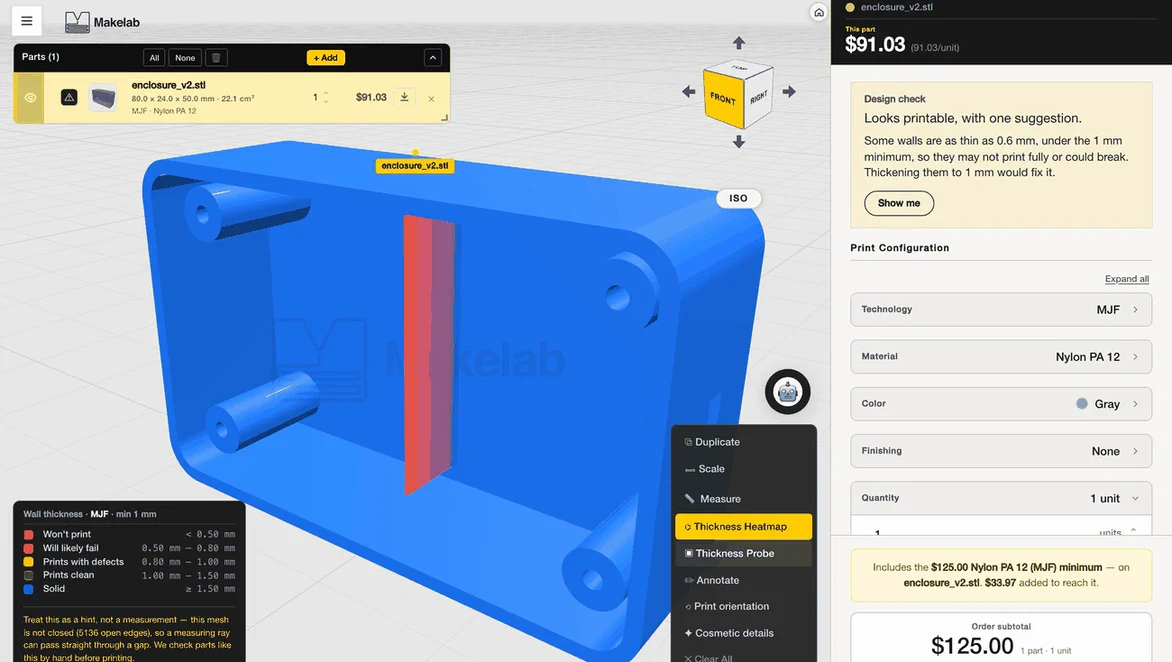
For plastic parts, Makelab gives you the date for your part before you order. The instant quote shows the price and every lead-time option, and checks wall thickness and part size as you upload. An engineer reviews every file before it prints, most parts are printed on our own floor in Brooklyn, and you can pick the process that meets your date from FDM, SLA, Industrial SLA, MJF and FGF.
All four services are compared on processes, sizes, lead times and shipping in Xometry vs Protolabs vs Craftcloud vs Makelab. To see the dates for your part, upload it at quote.makelab.com.