A conversation with Christina Perla, cofounder and CEO of Makelab
Ten years in production 3D printing teaches you something: you know exactly where things break.
Makelab has run dozens of orders a day, hundreds and sometimes thousands of parts, real manufacturing at real volume. For a long time, keeping that moving meant the team spent most of their time on coordination work: validating addresses, building labels by hand, fielding status questions, chasing down shipping details. Skilled people doing work that software should handle. So Christina Perla built that software.
“There was a need for multiple people to keep things running, staying as real-time updated as possible,” she says. “Bandwidth and efficiency suffered.”
Christina is the co-founder and CEO of Makelab. With her oversight and direction, the team built Makelab OS, the quoting and order platform that went live in August, as the tool she would have wanted from day one. The way she puts it: “You’re getting software that was built by experts who have been doing just this for a decade, with all the expertise injected in.” Ten years and tens of thousands of orders back that up. We sat down with her to talk about what broke, what changed, and where it’s going.
The factory floor ran on people. That was the problem.
Before Makelab OS, the process was mostly manual end to end. Customers sent files, the team reviewed them, sent quotes, fielded questions, coordinated shipping, and created labels by hand. It worked, but it didn’t scale. Every order needed a human touch at steps that had nothing to do with manufacturing expertise.
Christina has a way of describing what it felt like:
“It’s like that scene in The Pitt where they suddenly experience a cyberattack and have to work like they’re in the 1900s. Using fax machines, whiteboards, clipboards and paper forms. That’s what Makelab used to be like.” — Christina
“Scaling up was slowed down,” she says. “Now, Makelab OS has freed up time so the team can use their subject matter expertise for what it’s actually needed for.” The platform handles coordination and logistics so the people can focus on the manufacturing and design judgment that actually requires them.
What “failing” actually means
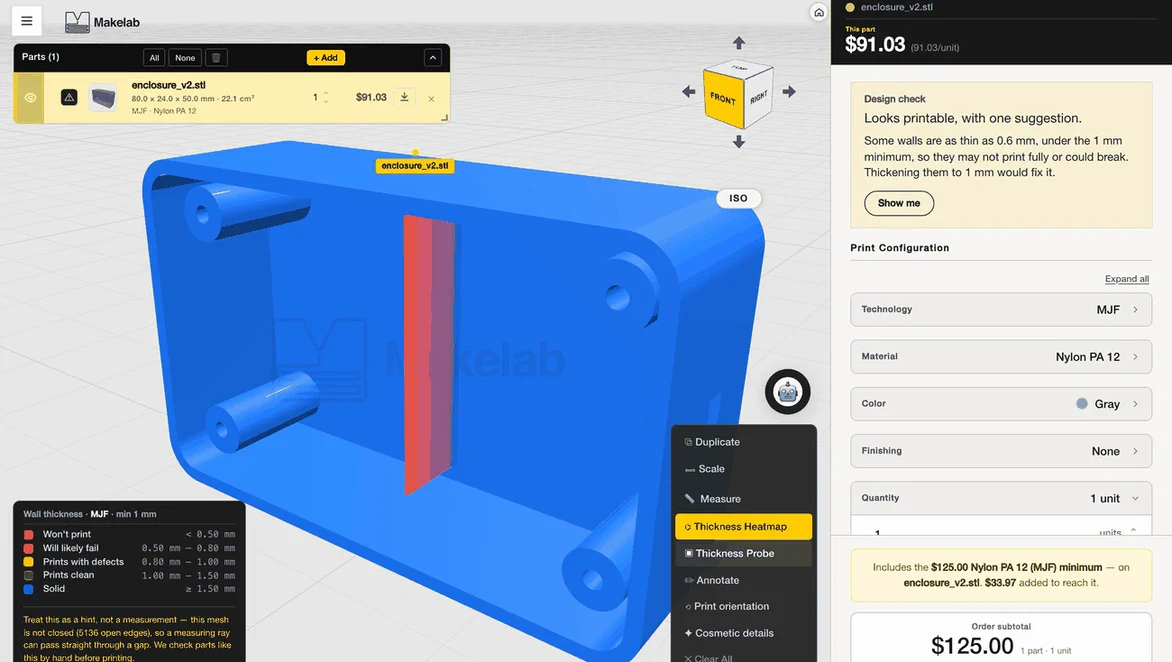
The DFM check at upload is the feature most customers encounter first. When a file gets flagged, the reasons are specific: open surfaces, overlapping triangles, geometric intersections, multiple bodies. A common example is 3D scans uploaded directly, where the mesh hasn’t been cleaned for manufacturing. Walls below minimum thickness get flagged before the order goes in. Parts submitted as a single merged file get flagged for splitting.
There’s also a sizing catch most people don’t expect. The portal detects when a file was uploaded in the wrong unit (millimeters when inches were intended) and flags it before the customer gets a wildly incorrect price. “It flags sizing issues in a way that’s super visual and easy to understand,” Christina says. “MM versus inches. Those things matter.”
And there’s more coming. An automated fix layer is in active development. Instead of routing issues back to the customer, the platform will resolve common problems at upload: wall thickening, mesh cleaning, hollow and split functions. Nothing proceeds without customer approval.
The logistics questions that used to live in inboxes
“Where is my part? When is it getting dispatched? Can you courier this? Shipping costs? Lead times?” When Christina lists the conversations that have moved out of email, the volume is the point. Every one of those questions is now answered inside the checkout flow, up front, before any payment is taken.
The change she says people underestimate most is address validation. “It’s perceived as small but it’s actually quite big,” she says. “Issues with addresses can cause a major delay.” The portal uses Google-validated addresses and auto-generates labels. Nothing is copy-pasted, nothing falls through a handoff.
“These things are common for ecommerce. It’s not like we invented the wheel. But in manufacturing, these features are usually luxuries that only larger companies have.” For customers, it also means showing up to a conversation with Makelab already informed. They’ve seen material options, reviewed constraints, and gotten a real price. The conversation that follows is more specific and faster to resolution: PETG versus TPU, tolerances, lead time.
What the platform deliberately doesn’t do
Christina is clear on this: the human element is a design decision, not a gap. “The human in the loop is crucial,” she says. “As of right now, the key to this is the human part of matching intent with execution.”
Makelab OS handles information, process, and visibility. Judgment is still a person’s job: the recommendation that changes a spec before the order goes in, the context from working with a customer over time, the read on what someone is actually trying to build. “Context from the consumer, our experience, considerations and recommendations. History and conversations. That’s where humans are most helpful.” Customers who come through the portal arrive more prepared, so that conversation can actually go somewhere.
What’s next
Makelab OS is adding DFAM (design for additive manufacturing) directly to the instant quoter, one of the most requested capabilities in the space. “It’s going to be more suggestive based on context,” Christina says. “Maybe we’ll add 3D modeling through prompting, even just for quoting and ballparking while engineers and designers are still working on their final files.”
There’s also Jarvis, a chatbot that surfaces inside the portal when it detects a user is stuck. The direction is a platform that participates in the design process itself, not just the order process, built on the same ten years of production know-how the team brings to every job.
Makelab is also launching a weekly newsletter covering new features, workflows, and how to get the most out of the platform. Each feature gets its own deep dive as it ships. Subscribe to the newsletter to stay current.
Makelab OS is live at quote.makelab.com. Upload a file, see your options, get a price. Our team is still there, doing the work they’re good at.