Upload a CAD file to almost any of the big 3D printing vendors and you get a price in seconds. The quote screens look alike. What happens after you click order differs a lot, and it decides who makes the small calls that shape your part.
The decisions inside a print
A 3D printed part is more than its CAD file. Someone decides how to orient it in the machine, which affects strength, surface finish and where support marks land. Someone decides whether a wall below the process minimum gets thickened, whether a long part gets split, and which face is the cosmetic one. On a functional prototype, those calls decide whether the snap fit snaps.
So the useful question about any service is who makes those calls, and whether you can reach that person.
How a marketplace handles it
Xometry describes itself as a marketplace with a global supplier network, which it puts at 5,000 suppliers. Shops apply to join and choose which jobs they take. Xometry reviews designs for manufacturability before a job reaches a partner, and it handles payment. Its site does not describe Xometry-owned production floors.
That model has real strengths. One upload can cover CNC machining, sheet metal, injection molding, casting and eight 3D printing processes, metal included. Xometry lists ISO 9001, ISO 13485, AS9100D and IATF 16949, and it is ITAR registered. If a program needs one supplier across many processes, or certifications on file, a marketplace is built for that.
The tradeoff is distance. Your questions go to Xometry's support team, and the partner shop that prints the part sits one step further away. A judgment call on your part is made in Xometry's review or at the partner shop, and you reach both through Xometry.
How a service bureau handles it
At a service bureau that runs its own machines, the people who quote the part are the people who print it. A question about orientation or a split goes to the engineer running the job.
The tradeoff runs the other way. A single shop covers fewer processes. Makelab only 3D prints, and only in plastics. If you need metal or machined aluminum, we are the wrong call.
Which fits your part
A marketplace tends to fit when:
- One order mixes processes, such as machined, molded and printed parts.
- You need metal 3D printing.
- The program requires AS9100, ISO 13485 or ITAR registration on file.
- The parts ship outside the US.
- The part is plastic and the details matter: fit, finish, orientation and where supports go.
- The part is large. Xometry lists 24 x 36 x 36 in without splitting, and Makelab prints one-piece parts up to 94 x 94 x 39 in (2400 × 2400 × 1000 mm) on FGF.
- The file needs work first, such as a repair, a rebuild from a scan or a redesign for printing, which our design engineering team handles.
- You are near New York and want to pick parts up or have them delivered the next day.
A simple test
If you are unsure, price the same file on both and compare more than the number. Look at the lead time, then ask a specific question about your part and see who answers and how specific the answer is.
Where Makelab fits
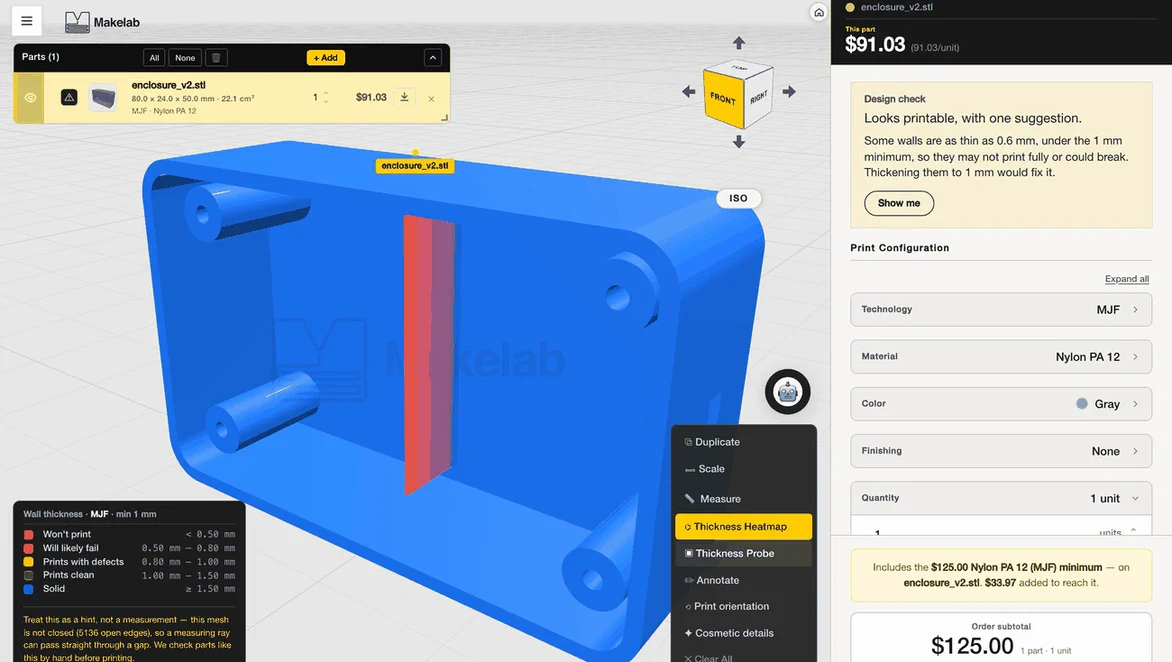
For plastic 3D printing, Makelab is the service bureau option. Every part is quoted, checked and run by our team in Brooklyn. Most parts are printed on our own floor. The instant quote checks wall thickness and part size as you upload, and an engineer reviews every file before it prints. We run FDM, SLA, Industrial SLA, MJF and FGF, with no minimum order and bulk discounts from 10 parts.
The full side-by-side, including lead times and shipping, is in Makelab vs Xometry. To see a price for your part, upload it at quote.makelab.com.